
What a supplement or health and wellness marketing agency should actually do, how pricing works, the questions that separate specialists from generalists and the red flags to avoid.
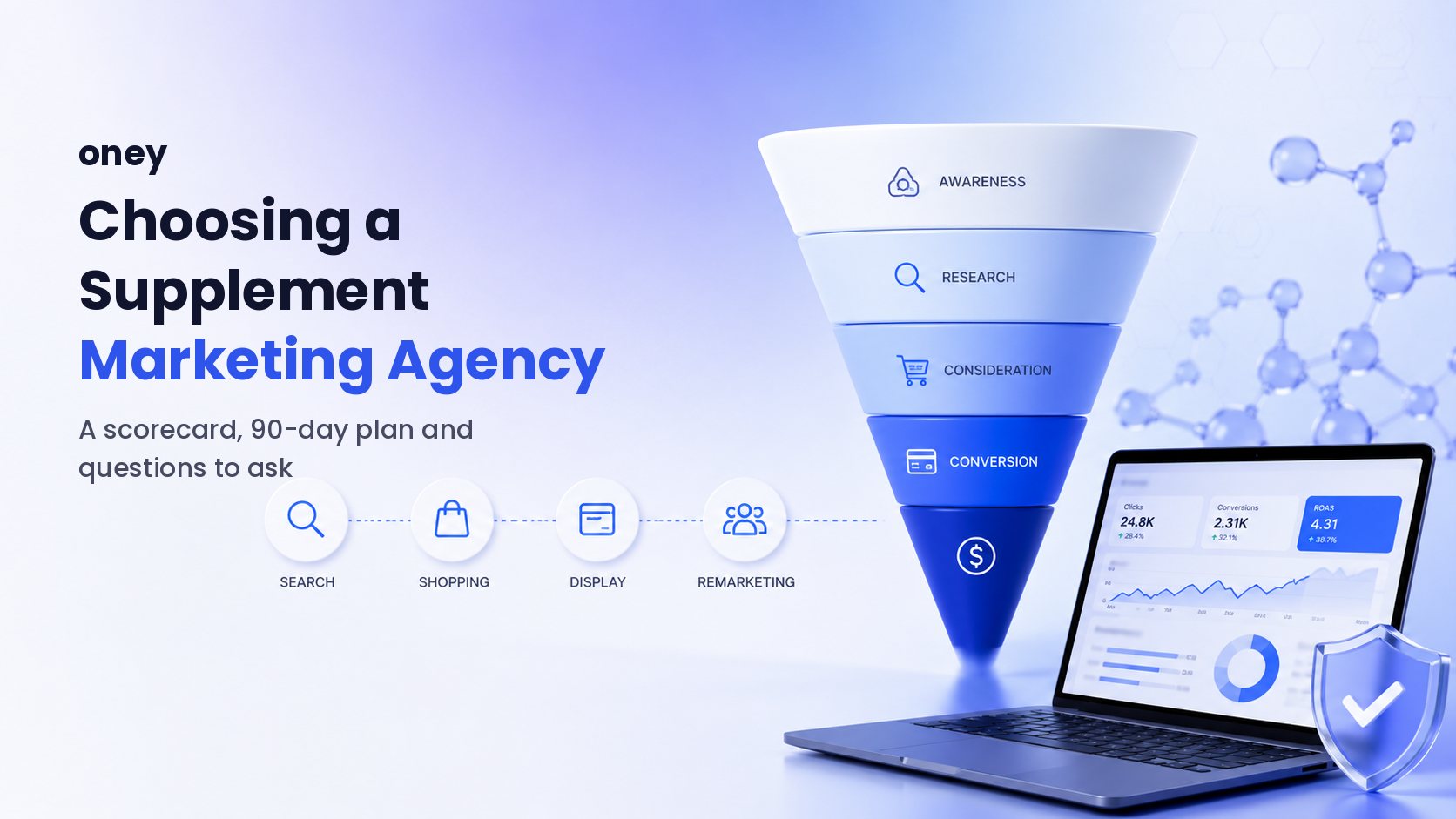
Hiring a supplement marketing agency is one of the biggest growth decisions a health and wellness brand makes. The right partner speeds up growth and protects your ad accounts. The wrong one can burn budget, trigger suspensions and leave you without access to your own data. Supplement, nutraceutical and peptide brands also face a problem most ecommerce brands don't: plenty of agencies are good at marketing, but few understand health advertising policy well enough to keep campaigns running.
This guide explains what a supplement or health and wellness marketing agency should do, the services that matter most, how agencies charge, the questions that separate specialists from generalists, and the red flags to watch for.
A specialist agency owns the growth channels that depend most on platform compliance:
Not every brand needs every service. An early-stage brand usually gets the most from a well-built Google Search and Shopping program. A brand with proven products and strong margins benefits from adding Meta and creator content.
Supplement advertising runs into rules most ecommerce categories never see: Google's Healthcare and medicines policy, unapproved substance lists, Meta's personal health rules, FTC endorsement and disclosure expectations, and FDA limits on structure/function versus disease claims. A generalist agency often learns these rules only after a suspension, on your account.
Signs you're working with a generalist:
Our Healthcare and medicines policy guide and Meta account recovery guide show how much policy knowledge day-to-day management in this category needs.
For a full vetting checklist, see 12 questions to ask before you sign and our buyer's guide to Google Ads agencies.
You'll usually see one of three pricing models:
| Model | How it works | Watch out for |
| Flat monthly retainer | Fixed fee for defined channels and scope | Scope creep and unclear deliverables |
| Percentage of ad spend | Fee scales with budget | An incentive to raise spend rather than efficiency |
| Hybrid or performance-linked | Base fee plus a bonus tied to agreed KPIs | KPIs that can be gamed, or attribution disputes |
We go through typical ranges and what's included in how much a Google Ads agency costs for a peptide brand. Whatever the model, ask exactly what's included: creative, landing pages, feed management, reporting and appeal handling are often billed separately.
An in-house marketer gives you focus and brand knowledge. An agency gives you breadth, cross-account pattern recognition and faster recovery when policy problems hit. Many brands do best with a hybrid: an in-house owner of brand and retention, and a specialist agency for paid media and compliance. Our in-house vs agency comparison covers the trade-offs, and signs it's time to switch agencies helps if you already have a partner who isn't delivering.
Oney Studio is a paid media agency for peptide and supplement brands. We run Google Ads and Meta Ads with compliance built into every campaign, and we publish our results:
More detail is on our services page and in our PPC case studies roundup.
Score each agency from 1 to 5 on each line after your calls:
| Criterion | What a 5 looks like |
| Category results | Several dated, specific case studies in supplements or peptides |
| Compliance process | Written pre-launch review, weekly policy monitoring, appeal experience |
| Account ownership | You own every account; agency has user access only |
| Transparency | Live dashboards, platform access, clear reporting on spend and fees |
| Strategic fit | Plan matches your stage, margins and product model |
| Team | You know who works on your account and how senior they are |
| Commercial terms | Clear scope, reasonable notice period, no long lock-in before results |
A full audit of accounts, tracking, feeds, landing pages and claims; a prioritised fix list; tracking corrected; quick wins launched. You should get a written plan, not just a kickoff call.
Campaign structure rebuilt where needed, Shopping and remarketing launched or improved, creative and copy tested within compliant frameworks, weekly reporting on performance and policy health.
Budget moved into proven campaigns, value-based bidding introduced where data allows, new channels planned. By now you should see a clear trend in new-customer revenue and efficiency, and have an honest view of what's working and what isn't.
It plans and manages the channels that grow a supplement brand (usually paid search, paid social, Shopping, SEO and retention) while keeping claims, creative and landing pages within platform and regulatory rules.
Pricing is usually a flat retainer, a percentage of ad spend, or a hybrid with performance incentives. Costs depend on channels, spend and scope. Check what's included, especially creative and compliance work.
"Health and wellness" is broader and can include clinics, fitness and wellness services. If you sell supplements or peptides, choose a partner with specific experience of supplement advertising policy and published results in that category.
Yes. Your business should own the ad accounts, Merchant Center, analytics and pixels, and give the agency user access. That protects your data and history if you ever change partners.
Brand and high-intent search campaigns can show results within weeks. Cold accounts in regulated categories usually need a learning phase before scaling. Our cold-start case study reached positive ROAS in 60 days.
Book a free audit and we'll tell you honestly what we'd change in your account, and whether we're the right fit.
Get a free 30-minute audit of your Google Ads or Meta Ads account. We’ll review compliance, structure, and growth opportunities — no strings attached.
Book a Free Audit