
The hub guide to peptide marketing: pick the right business model, choose channels that fit, build the compliance foundation, then budget, measure and scale without losing your ad accounts.
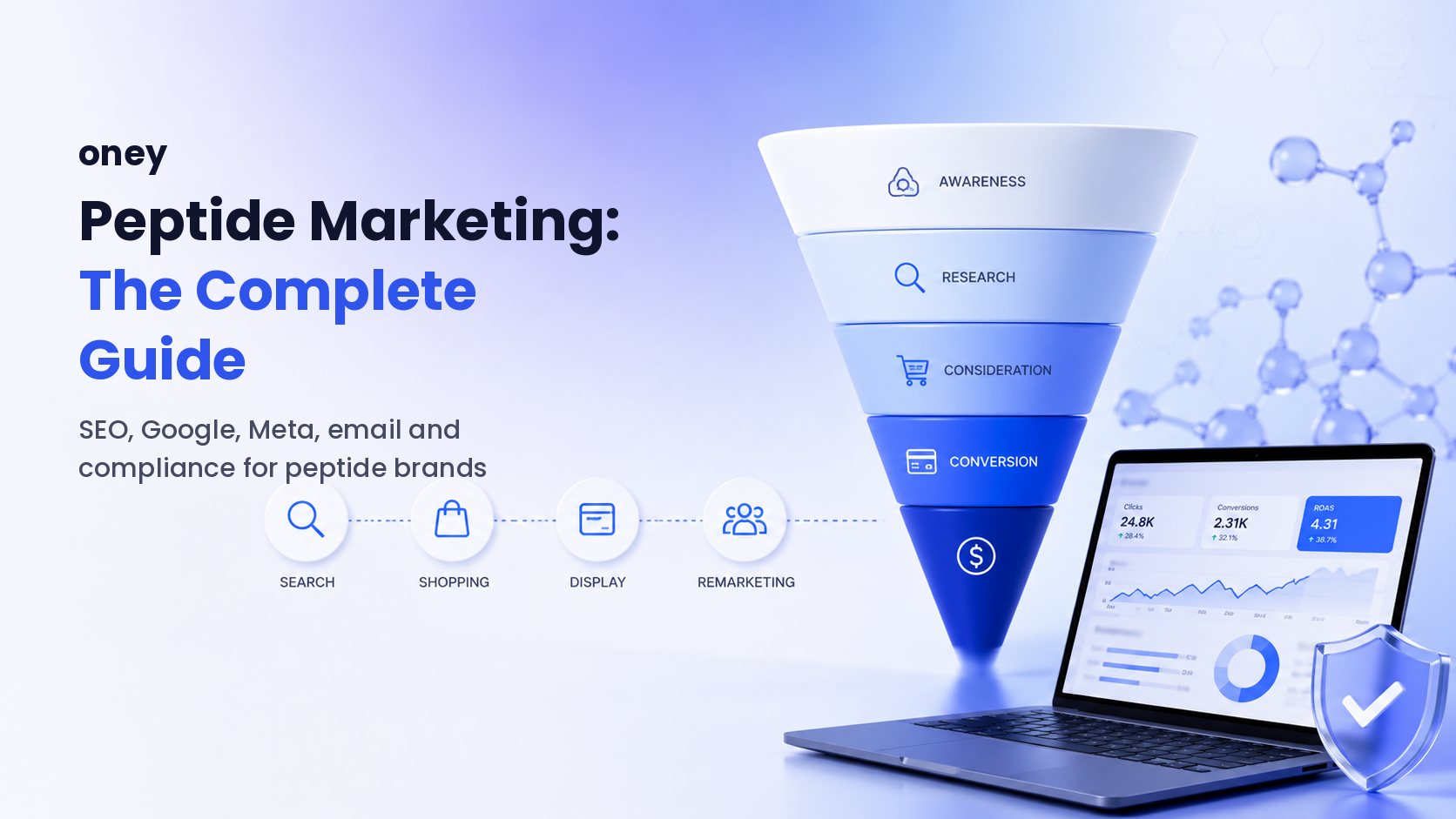
Peptide marketing breaks most of the rules that work for ordinary ecommerce. The products sit between cosmetics, dietary supplements, research chemicals and prescription medicine, and every ad platform, payment processor and regulator treats those categories differently. A tactic that is fine for a collagen gummy can get a research-peptide store's ad account suspended the same afternoon.
This guide is the hub for everything we publish on peptide marketing. It covers which business model you are really in, which channels work for each model, the compliance rules that decide whether your ads keep running, how to budget and measure, and how brands actually scale. Each section links to a deeper guide when you need detail.
Peptide marketing is the work of getting a peptide product in front of the right buyer, and staying within the policies of the platforms and regulators involved. In practice it covers paid search, paid social, Shopping feeds, SEO and AI-search visibility, email, affiliates and landing pages. What makes it a specialism is compliance. Google, Meta, TikTok, Amazon, Stripe and card networks all set their own rules for health products, and they enforce them automatically.
Most peptide brands don't fail at marketing because their creative is weak. They fail because an account gets suspended mid-scale, a payment processor pulls out, or a landing page says something the product is not legally allowed to claim. Good peptide marketing puts those risks first and growth second. In our experience that's also the order that grows fastest over twelve months.
Before choosing channels or writing a headline, be honest about your category. Platforms judge you on what you sell, how you describe it, and who you sell it to.
Many brands sit across two categories, such as a collagen line plus a research catalog. That's workable, but those product lines need separate campaigns, landing pages and often separate domains, so one line's risk can't reach the other.
No single channel wins for every peptide brand. The table below shows where each channel tends to fit and the main thing that goes wrong.
| Channel | Best fit | Main risk | Deep dive |
|---|---|---|---|
| Google Search | All three models; captures existing demand | Unapproved Substances and Healthcare policy enforcement | Google Ads policy for peptide brands |
| Google Shopping / Merchant Center | Supplement and cosmetic peptides | Merchant Center suspensions for product data or claims | Google Shopping for peptide brands |
| Meta (Facebook & Instagram) | Collagen, skincare, supplements; demand creation | Personal health policy, before/after imagery, disabled accounts | Meta Ads scaling guide |
| Microsoft (Bing) Ads | Search demand at lower CPCs | Similar policy scope to Google, smaller volume | Bing Ads for peptide brands |
| YouTube | Education-led brands with strong founders | Claims made on camera are reviewed like ad copy | YouTube Ads guide |
| TikTok | Supplements and skincare with young audiences | Strict healthcare rules and creator claims | TikTok Ads for peptide brands |
| SEO & AI search | Every model; builds compounding, ban-proof traffic | Slow to build; thin content doesn't rank | AI search visibility guide |
| Email & SMS | Repeat purchase and subscriptions | Deliverability and claims in flows | Peptide brand email marketing |
| Affiliates & creators | Brands with strong community | Affiliates making claims you can't control; FTC disclosure | Affiliate marketing guide |
For most brands we start with Google Search, because it captures people already looking for what you sell. Then we add Shopping (where eligible) and a remarketing layer, and only open Meta or TikTok once the offer and claims framework are proven. SEO vs PPC for peptide brands goes through that sequencing decision.
Every durable peptide account we manage shares the same foundations. Get these right first and most disapprovals never happen.
Describe what the product is, how it is made, and what quality evidence backs it, not what it will do to a body. Supplement brands can use structure/function wording ("supports skin elasticity") along with the required FDA disclaimer. They cannot use disease or treatment claims ("treats joint pain"). Research-use-only suppliers can't make human-benefit claims of any kind. Our compliant ad copy guide and copy templates show working examples.
Platforms review the destination, not only the ad. A compliant headline that leads to a product page with dosing tables or testimonials describing personal use will still be disapproved. The landing page compliance checklist and research-use-only landing page copy guide list what reviewers look for.
Compound names used as keywords, condition-based audiences and broad match terms that drift into medical queries are three of the fastest ways to trigger reviews. Use tight match types, a maintained negative keyword list and interest-based rather than condition-based targeting.
Separate brand, category and product-line campaigns, so a policy issue on one compound never spreads across the whole account. We set out our structure in Google Ads account structure for multi-compound brands.
Marketing that works can still be stopped by a processor. Plan payments before you scale traffic. Our payment processing guide explains high-risk merchant accounts and what processors look at on your site.
Peptide accounts need a learning phase that's longer than in most ecommerce categories. Cold accounts have no conversion history, some keywords will be limited by policy, and Smart Bidding needs data before it helps. We usually start on tightly controlled campaigns and manual or conservative bidding, then move to value-based bidding once conversion volume supports it.
That sequencing is how a cold-start peptide recovery brand reached positive ROAS within 60 days and $67,200 in monthly conversion value by month six at 3.8x ROAS. For realistic spend ranges at each stage, see our peptide brand advertising budget guide.
Many peptide brands under-report paid performance because consent banners, ad blockers and checkout redirects drop conversions. Set up server-side or enhanced conversions and import margin-aware conversion values, so bidding optimizes for profit rather than raw revenue. Our GA4 enhanced conversions guide walks through the setup.
Track policy health as closely as ROAS: disapproval counts, limited-by-policy keywords and account-level warnings. Google gives advance notice before suspending accounts for many non-egregious policies, and monitoring for that warning is one of the simplest ways to protect revenue.
Scaling a peptide brand means adding layers (Shopping, Performance Max where eligible, Display prospecting, remarketing, then new platforms) instead of pushing budget into one campaign. Our three published peptide case studies all follow this pattern:
For the full scaling playbook, read how to scale a peptide brand with paid ads and, for larger accounts, scaling ad spend from $100K to $1M a month.
Even careful accounts get disapprovals. What matters is how quickly and cleanly you respond:
A specialist agency is worth it when a suspension would cost more than the retainer, or when you are ready to scale past what one channel can deliver. Look for published peptide results, a documented compliance process and clear account ownership (the ad account should always belong to you). Our guide to choosing a supplement and wellness marketing agency and 12 questions to ask a PPC agency will help you vet any partner, including us.
Different buyers need different messages, and so do different platforms. A simple way to plan is to map every channel and message to a stage of the buying journey:
| Stage | What the buyer is doing | Channels | Message focus |
| Awareness | Learning what peptides are and which category fits them | SEO content, YouTube, Meta (supplement peptides), creators | Education, ingredient science, brand story |
| Consideration | Comparing brands, reading reviews, checking quality | Google Search (category terms), comparison content, email | Testing, COAs, sourcing, transparency, guarantees |
| Purchase | Searching for a brand or product, ready to buy | Brand Search, Shopping, remarketing | Offer, availability, shipping, trust signals |
| Retention | Reordering or trying adjacent products | Email, SMS, subscriptions, loyalty | Replenishment, bundles, education, community |
Most underperforming peptide accounts put all their budget into the purchase stage and wonder why growth stalls once brand demand runs out. The brands that scale keep feeding awareness and consideration with compliant educational content, then capture that demand with Search and remarketing.
Here's how we typically sequence the first quarter for a brand launching paid media for the first time:
This is the same sequence behind the cold-start recovery brand that reached positive ROAS within 60 days.
Yes, depending on what you sell and how you position it. Cosmetic and supplement peptides can run under standard policies with compliant claims. Research-use-only suppliers can run only with strict RUO positioning across the full funnel. Prescription and telehealth services need certification first. Compounds covered by Google's Unapproved Substances policy can't be promoted however they are described.
Collagen and skincare peptides are regularly advertised on Meta when the creative avoids before/after imagery, disease claims and condition-based targeting. Injectable and research peptides are much harder to run on Meta, and accounts that try are frequently disabled.
For most brands, Google Search is the first channel because it captures existing demand. SEO builds a traffic source that no ad policy can switch off. Meta works best for supplement-style peptides once claims and creative are proven.
It depends on margins, average order value and your model, but you need enough budget to get through a learning phase with meaningful conversion data. Our budget guide gives stage-by-stage ranges.
Pharmacies, telehealth providers and other prescribing businesses usually do. Most supplement and cosmetic peptide brands do not. See our LegitScript certification guide for who needs it and what it costs.
We'll review your account, landing pages and claims, then tell you which channels are realistic for your model and what to fix first.
Get a free 30-minute audit of your Google Ads or Meta Ads account. We’ll review compliance, structure, and growth opportunities — no strings attached.
Book a Free Audit